





 Telegram
Cleaning is the “work” of robots
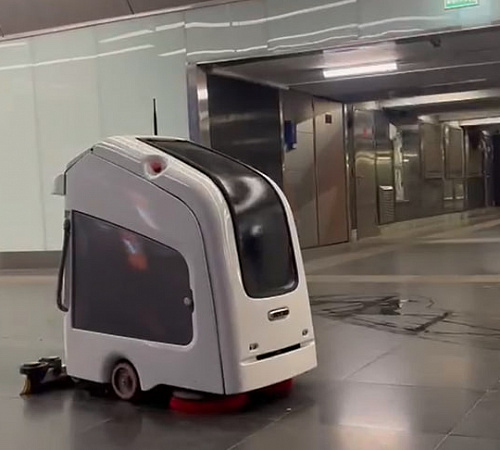
The Russian company Yaku Robotics has announced the launch of sales of its first autonomous cleaning robot “Unit”.
After a successful pilot in public spaces in Moscow and internal testing that lasted more than a year, the company announced its readiness to scale sales.
“This year, the company plans to sign distribution partnership agreements with 10 companies. YaCu Robotics does not plan to engage in retail sales; the goal is to focus on the product, so the distributor pool will be carefully selected and limited” - said the company’s founder, Robert Gasparyan.At the start of sales, the robot costs 2 million rubles (an additional docking station is also required for charging, draining, and refilling water, costing 400 thousand rubles). By default, the floor scrubber operates in manual mode, but after subscribing to the company’s software, the “WOW” effect appears, and the robot becomes a fully autonomous floor-cleaning machine. The company also provides a lifetime guarantee for software updates and improvements.
With simple calculations, the payback period for Unit at this price is 1.5 years, and each month cleaning costs in your company will be reduced by 60–70 thousand rubles.
Pro hardware
Key specifications:
-
One charge lasts up to 6 hours of cleaning, during which the robot can cover 4,000 m² (including display areas — equivalent to a full hypermarket).
-
Two 50-liter tanks; cleaning components from leading brands are selected to allow replacement with compatible alternatives.
-
Robot dimensions: 900/560/800 mm; weight: 130 kg.
Deployment of the robot takes 3–4 days. The first two days involve beacon measurements, facility mapping, and route planning. Then one day is allocated for testing, and it’s ready to go!
The key competency of the team is the driver software responsible for autonomous movement. This is where the product differs from competitors—although, to be fair, there are none in Russia.
The movement logic is structured as follows:
-
Beacons are installed around the perimeter of the facility. By interacting with the robot’s tag, they provide absolute navigation (similar to GPS on your smartphone).
-
Cleaning routes (multiple options possible) are uploaded into the robot, and the system strictly follows them, ensuring 100% coverage of the cleaning area.
-
Result — the autonomous floor-cleaning machine efficiently cleans spaces of any size and purpose.
Competing robots do not have the capability to operate effectively in large spaces because such beacon systems—often essential for true autonomy—are not widely used. Additionally, this robot does not rely on middleware or interpreters (such as ROS), unlike 99% of competitors, which in current conditions provides protection against potential restrictions or service shutdowns by external vendors.
The remaining question is safety, and here everything is straightforward. A standard set of sensors ensures the protection of people and property. These “guards” include LiDAR, radar, a 3D camera, and floor sensors (redundant technologies working together).
It is also worth noting that YaCu Robotics, when developing its driver software, designed it as a hardware-software complex that can be installed on any wheeled platform—another robot or even a car—and, “voilà!”, it becomes autonomous. As a result, the company has already created a fully automated and controlled Toyota Prius, although currently only for closed areas.
-
 лайф наших роботов
 -
самые крутые пилоты
-
говорим всю правду о разработке
