Driver 2.0
How we made the robot more confident and its motion smoother
For more than a year we thoroughly rewrote everything we had built in the first 5 years. The difficulty of the project is that universality always costs time — but we decided that motion quality is worth every minute.
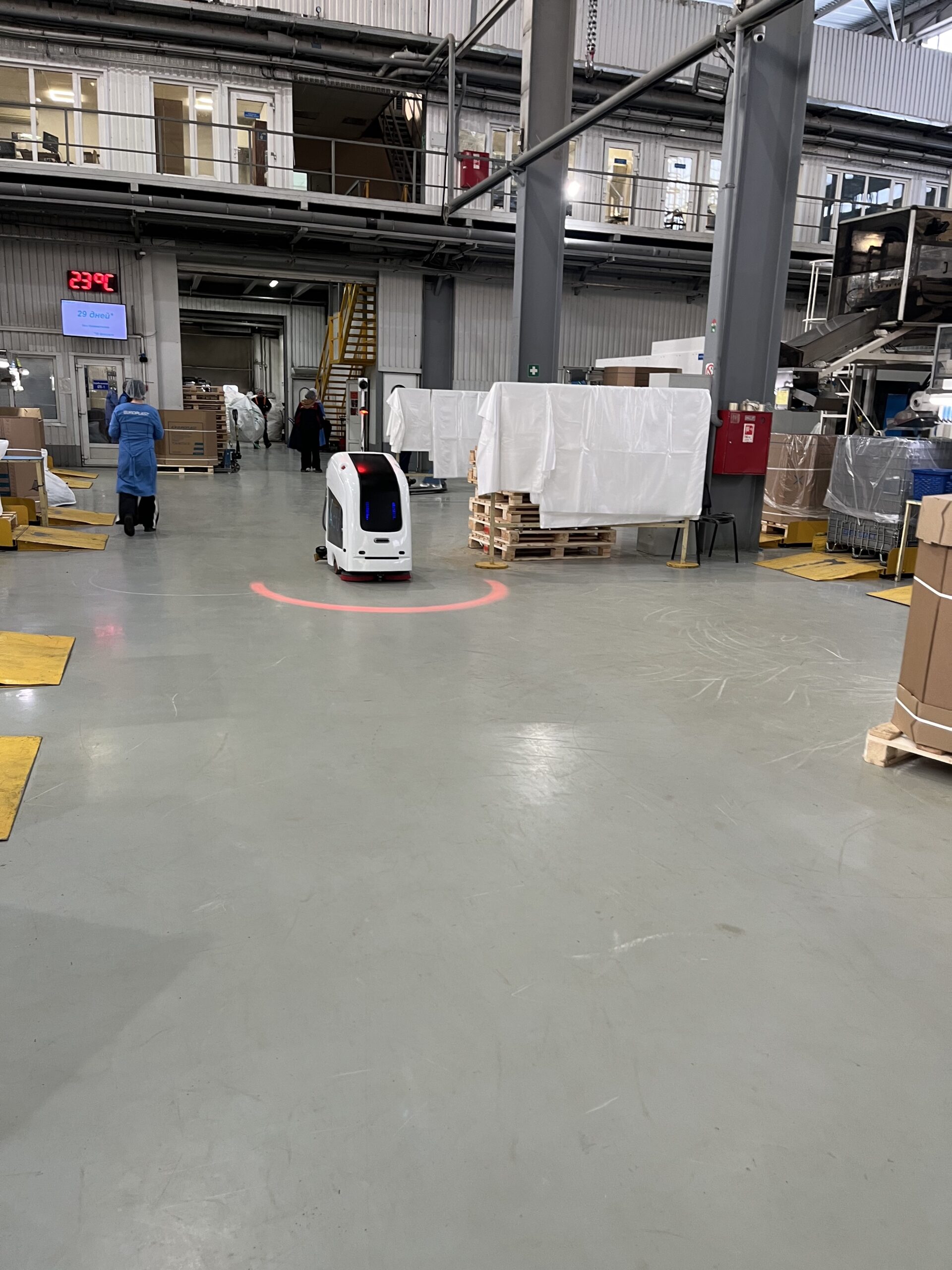
Testing the updated Driver platform on the Unit cleaning robot
The robot has become much more confident. It now behaves like a skilled taxi driver who uses every degree of freedom to get out of the tightest space. No hesitation, unnecessary stops or jerky movements — only smoothness and precision.
Solving this took months, and before that, more months of research into the equations of dynamic motion. There is almost no information on the subject online, and we were told more than once that the problem could not be solved. But we went ahead and solved it.
What exactly changed in the motion is described below. All these improvements apply equally to the Unit cleaning robot, to autonomous FMR transporters, to the CarGo 300 AMR robot and to any other vehicle equipped with Driver.
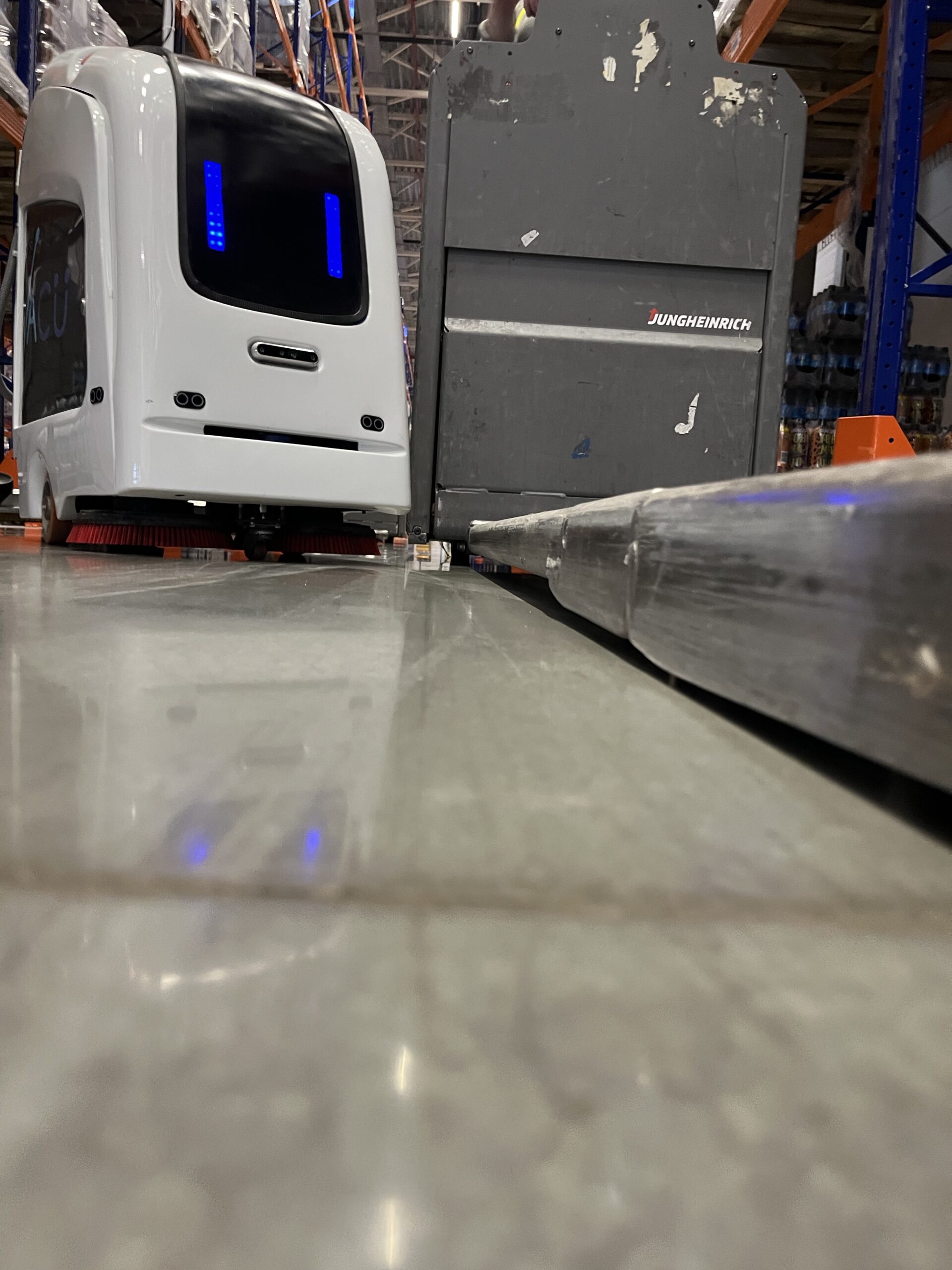
The Unit cleaning robot was one of the first to receive the Driver 2.0 update
What changed in Driver over the past year
1. Optimised dynamic transitions between trajectory segments
We refined the algorithm that joins neighbouring route segments, based on Reeds–Shepp paths. The system now applies artificial turning-radius limits where needed and removes them when space allows.
How motion improved: the jerks and sharp changes of direction where straight segments meet turns are gone. The robot passes these joints smoothly, without micro-stops or unnecessary re-planning. It now leaves the trajectory far less often on complex sections.
2. Improved gyroscope calibration tactics and algorithm
We reworked the initial and dynamic calibration of the inertial sensors and added compensation for temperature drift and vibration noise.
How motion improved: the robot determines its orientation more accurately. This is especially noticeable on slippery floors, when reversing and when odometry readings “slip”. The robot holds its course more steadily on straight sections.
3. Advanced speed control depending on the situation
We introduced an adaptive controller that changes linear and angular speeds in real time. It takes into account what is happening around the robot, what it plans to do next and how it is moving right now.
How motion improved: the robot no longer drives at one constant speed but adapts to the situation. It speeds up in corridors and on straight sections, slows down smoothly before turns and reduces speed in tight spaces for precise manoeuvring. Motion has become more “human” and predictable.
4. A new model of interaction between free and strict routing
We reworked the algorithm responsible for how two modes work together: strictly following the set route and free navigation around obstacles. We refined the logic of switching between them.
How motion improved: the robot no longer “gets lost” when the planned route is blocked. It confidently takes a detour in free mode and, once the obstacle is gone, smoothly returns to the set trajectory without jerking or searching for a reconnection point.
5. Synchronised motion planner and navigation hardware
We aligned the timing cycles of the trajectory planner and all connected sensors (lidars, cameras, radars). Sensor data now arrives with a guaranteed timestamp tied to the moment of motion.
How motion improved: situations in which the robot makes decisions on outdated data are completely eliminated. Reaction to sudden obstacles is faster and positioning in motion is more accurate.
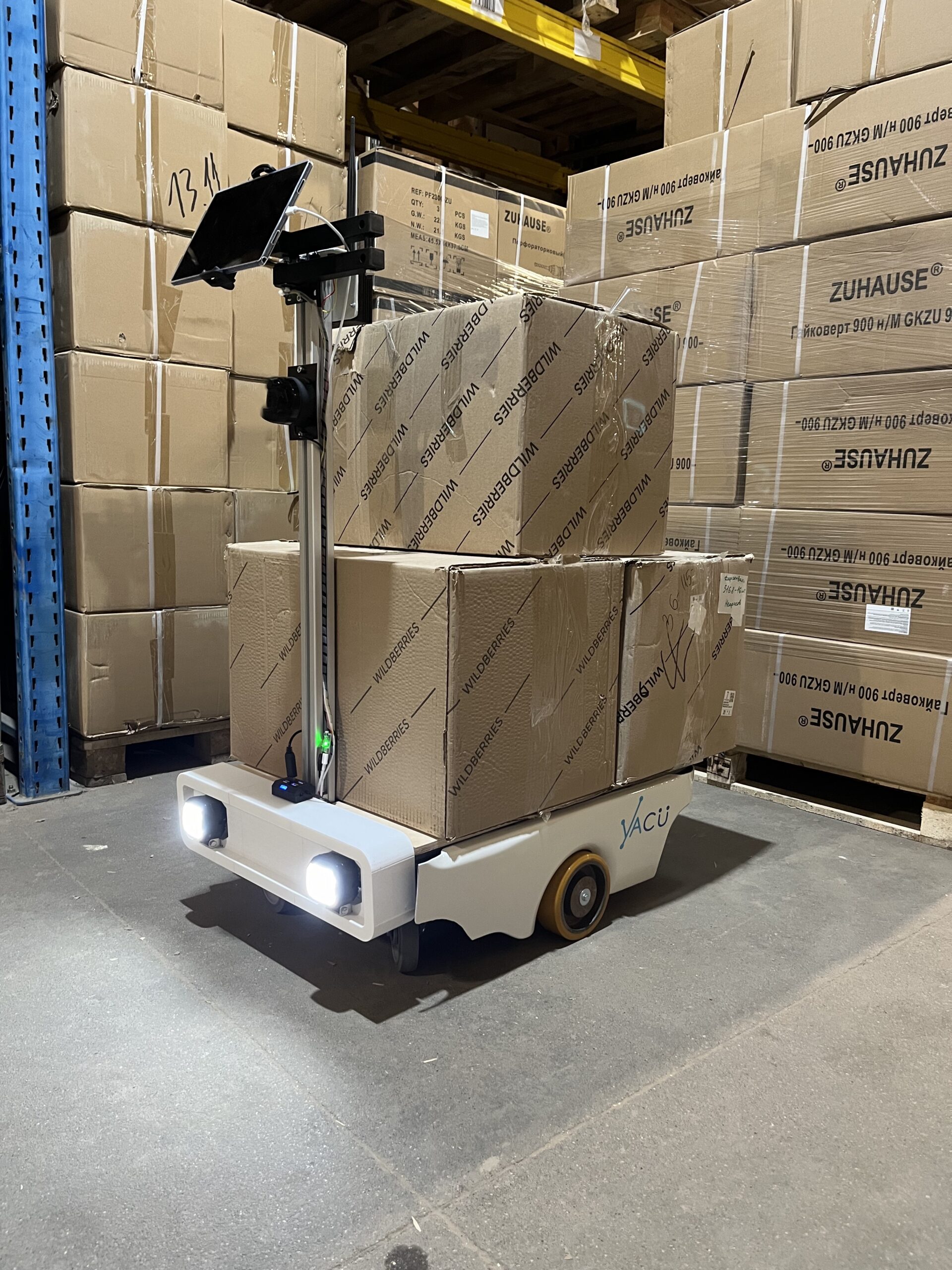
A dual-layer safety system: the robot always knows what is happening nearby
6. Dual-layer collision warning and avoidance
We introduced two parallel safety layers: one in the local coordinate system (tied to the robot) and one in the global system (tied to the site map).
How motion improved: the local layer works like an instinct — it stops or diverts the robot when an object suddenly appears nearby, even if the global map says the space is empty. The global layer handles strategic planning of detours. As a result the robot became both safer and more efficient: it does not flinch at every shadow but reliably avoids real collisions.
7. Improved vector field geometry in SLAM
We refined the mathematical model of the vector field used for mapping and localisation with SLAM (simultaneous localisation and mapping).
How motion improved: mapping is more stable in complex environments with repeating structures (long corridors, rows of racks). The robot determines its position more accurately when returning to familiar areas, and positioning error accumulates less on long routes.
Flagship product
Unit — autonomous cleaning robot
A professional robot for dry and wet cleaning in warehouses, shopping malls and production premises. It runs on the Driver platform with hybrid SLAM+RTLS navigation.
- Productivity: up to 1,840 m²/h (≈19,800 sq ft/h) confirmed in pilots
- Navigation: hybrid SLAM+RTLS
- Control: call from a phone / web interface
- Runtime: up to 5 hours
- Tank capacity: 50 L
“Unit passed a stress test in a real hypermarket and showed excellent results. The smoothness of motion and the accuracy of navigation exceeded expectations.”
Learn more about Unit
Unit cleaning robot
How did this affect cleaning?
All these improvements directly affected the work of the Unit cleaning robot. Smooth motion is critical for cleaning quality: sharp jerks leave streaks, and inaccurate positioning leads to missed areas. Now Unit:
- ➡️ Enters turns smoothly without leaving dirty stripes
- ➡️ Drives around obstacles confidently without falling behind the cleaning schedule
- ➡️ Joins passes more precisely, eliminating gaps
- ➡️ Works more quietly and efficiently thanks to optimised trajectories
The same algorithms control FMR pallet transporters and any other vehicle with Driver.
Universality without compromise
Driver can be built into any wheeled vehicle — from the Unit cleaning robot to heavy forklifts and cars. All the algorithms described above work on any chassis: we made them hardware-independent.
This means a cleaning company using Unit and a logistics centre with FMR robots get equally smooth, precise and safe motion. A single technology base makes it easier to maintain and grow a robot fleet — and to manage it in the RMS fleet management system.
In conclusion
We do not promise that the work stops here. The equations of dynamic motion are an endless path of optimisation. But today our Unit cleaning robot and FMR transporters drive like nobody else on the market.
Smoothly. Confidently. Predictably.
Driver 2.0 — a new degree of freedom for your robots.


 Telegram