


 Telegram
Transport robot for manufacturing line-side delivery with CarGo 300
CarGo 300 brings parts and blanks to assembly lines and machines, moves loads between halls and takes finished goods away. It works on kanban calls or on schedule, alongside people and vehicles, without magnetic tape on the floor.
- 300 kgpayload
- 3 shiftswithout breaks
- hoursto launch, not months
- from $14,500payback < 1 year

In-plant logistics without manual carts
In a factory, something is always on the move: parts from the warehouse to the line, blanks to machines, semi-finished goods between work areas, finished products to shipping. When people do it with carts, assemblers lose time waiting and every shift needs dedicated transport staff.
CarGo 300 is an autonomous mobile robot that takes over these trips. In its first deployment at a large automotive plant, CarGo carried parts from storage to the assembly line on a route several hundred meters long through heavy traffic of people and vehicles — and handled it.
Manufacturing use cases
Line-side delivery
Kanban operation: the line calls for parts, the robot brings them from storage and takes empty containers back. Assemblers stay at their stations.
Transport between halls
Loop trips between halls and buildings. RTLS navigation keeps the route on large sites.
Supplying blanks to machines
Delivering blanks and taking away machined parts on the work area schedule.
Removing finished goods and waste
Finished goods to shipping, packaging waste to collection points.
One robot — hundreds of tasks
CarGo was not designed for a single operation. Today it works on kanban and brings parts on request, tomorrow it switches to loop trips between halls, the day after — to removing packaging waste. You do not replace the robot, you change its task in the app.
Routes change in minutes: an employee opens the app on a phone, picks a point and sends the robot. The web interface works from any computer, and tasks can arrive automatically from your MES or ERP.

Safety on the shop floor
Two protection layers
The local layer instantly stops or diverts the robot when a person appears nearby, the global layer plans detours on the map in advance.
Situation-aware speed
Accelerates on straight sections and slows down smoothly before turns, in narrow aisles and near people.
100% route execution
Hybrid SLAM+RTLS navigation: the robot does not get lost even when totes are moved or a forklift passes by.
Motion and safety algorithms are part of Driver 2.0.
CarGo 300 specifications
| Class | autonomous mobile robot (AMR) |
|---|---|
| Payload | up to 300 kg |
| Deck dimensions | 900 × 560 × 250 mm |
| Navigation | hybrid SLAM+RTLS, centimetre accuracy |
| Infrastructure | no magnetic tape or floor markers; RTLS anchors on walls or ceiling |
| Control | smartphone app, web interface, MES / ERP / WMS integration |
| Operating mode | 24/7, automatic return to charging |
| Launch | within a few hours |
Speed, battery runtime and configuration are matched to your plant. Full description — on the CarGo 300 page.
Economics in manufacturing
| CarGo 300 price | from $14,500 depending on order volume |
|---|---|
| Comparable AMRs from other vendors | often several times more for the hardware alone, plus deployment and integration |
| Payback | typically under one year, then pure savings |
How mobile robots change manufacturing — read the article.
How we launch CarGo at a plant
Route analysis
We study part and tote flows, trip frequency and shifts, and calculate the number of robots and payback.
Map and points
The robot builds a map of the hall; RTLS anchors are installed if needed, loading and unloading points are set.
Launch
Launch within hours, staff training, MES/ERP and RMS integration.
The system watches.
Tasks, routes, monitoring and alerts — all CarGo robots at your plant in one fleet management system.
How RMS works →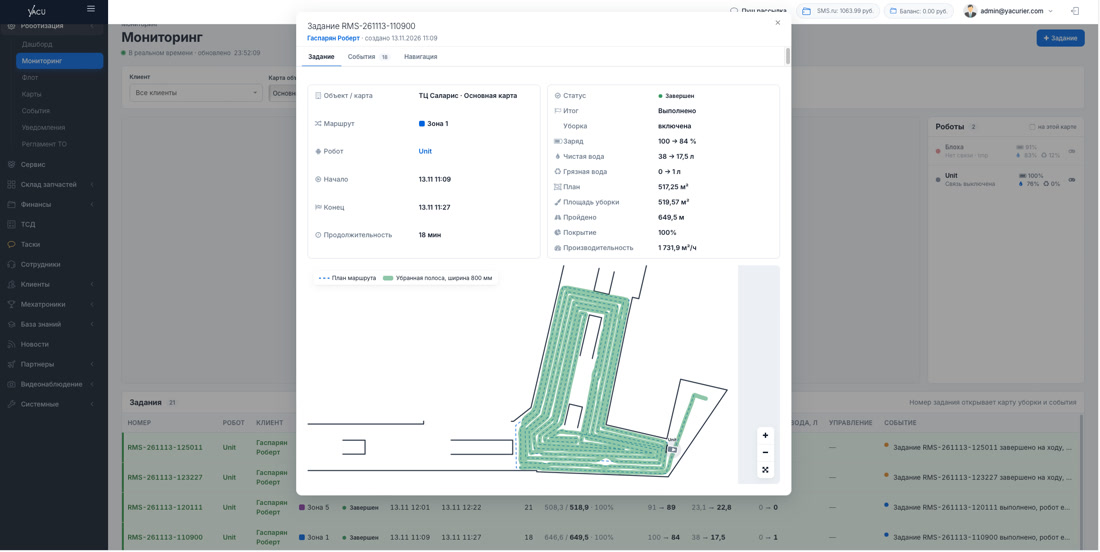
Frequently asked questions
What can a transport robot carry in a factory?
Unit loads up to 300 kg in total on a 900×560 mm deck: part containers, totes, blanks, semi-finished goods, finished products and packaging waste.
Can the robot work with kanban?
Yes. The line or an employee calls the robot from a phone or the web interface, and with integration the request comes from your MES/ERP automatically. The robot brings parts and takes empty containers back.
Where is CarGo already working?
In its first deployment at a large automotive plant, CarGo carried parts from storage to the assembly line on a route several hundred meters long through heavy traffic of people and vehicles.
Do we need to change the plant infrastructure?
No. Magnetic tape and floor markers are not needed: the robot drives the route once and builds a map. For RTLS, anchors are mounted on walls or under the ceiling.
Is it safe to work next to the robot?
Yes. The local safety layer stops the robot instantly when a person appears, the global layer plans detours, and speed drops in narrow aisles and near people.
How much does a transport robot for manufacturing cost?
CarGo 300 starts from $14,500 depending on order volume and typically pays back in under a year.
Related articles



Warehouse and transport robots by YaCu
Leave a request — we will analyse part and tote routes, calculate the number of robots and payback and send you the CarGo 300 presentation.
Or call us: +1 (888) 831-8224