


 Telegram
Transport robot for warehouses CarGo 300 autonomous mobile robot
CarGo 300 carries boxes, totes and containers up to 300 kg between receiving, storage, picking and shipping. It plans its own path, drives around people and forklifts, takes tasks from your WMS and works three shifts.
- 300 kgpayload
- SLAM+RTLShybrid navigation
- 24/7returns to charge by itself
- from $14,500payback < 1 year
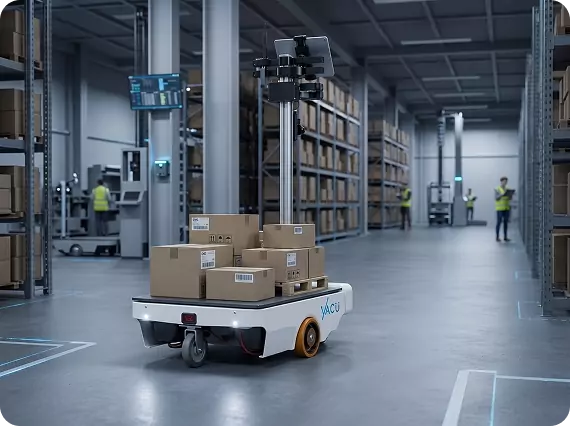
Which warehouse tasks a transport robot takes over
Every warehouse and distribution center repeats the same moves every day: boxes from receiving to storage, totes to pickers, completed orders to shipping and empty containers back. It is monotonous work usually done by warehouse staff with manual carts — a significant labor cost on every shift.
CarGo 300 is an autonomous mobile robot (AMR) that takes over these trips. It needs no magnetic tape or floor markers: the robot drives the route once, remembers racks and aisles and then travels on its own. Staff send tasks from a phone, and with integration the tasks come straight from your WMS.
Where CarGo 300 works in a warehouse
Receiving → storage
Moving boxes and totes from the receiving area to storage locations.
Supplying picking stations
Delivering goods and empty totes to order pickers so they do not walk the warehouse with carts.
Picking → shipping
Taking completed orders to the shipping area as soon as they are ready.
Returning totes and removing packaging waste
Scheduled loop trips with empty containers and packaging waste.
CarGo 300, AGV or FMR forklift: which to choose
We offer several classes of warehouse robots. The choice depends on what you move and how.
| Task | Solution | Why |
|---|---|---|
| Boxes, totes and containers up to 300 kg between zones | CarGo 300 (AMR) | No infrastructure required; routes change in the app in minutes |
| Moving and stacking pallets | FMR autonomous forklift | Lifts and carries pallets across the entire warehouse |
| Bringing shelves to picking stations | Goods-to-person AGV | Speeds up order picking in the storage area |
| Managing all robots together | RMS + your WMS | The WMS plans tasks, RMS distributes them across robots |
Does not get lost in a live warehouse
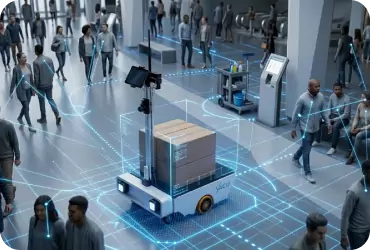
A real warehouse is not a trade show booth: racks get moved, temporary batches sit in aisles, forklifts do not give way and lighting is uneven. Robots that rely on LiDAR alone start making mistakes in such conditions.
CarGo 300 uses hybrid SLAM+RTLS navigation. SLAM gives the robot a map of the building, RTLS gives absolute coordinates from radio beacons with centimetre accuracy. Together they deliver 100% route execution: the robot knows where it is even if a passing forklift “blinds” it for a moment.
Safety comes from the two protection layers of Driver 2.0: the local layer instantly stops the robot when a person appears nearby, the global layer plans detours in advance.
WMS integration and fleet management
Call from a phone
A core feature: open the app, choose a task and send the robot.
Tasks from your WMS
With integration, transport tasks reach the robot automatically from your warehouse management system.
Fleet in RMS
Multiple robots, charging queues, routes and the status of every CarGo in one fleet management system.
How the three levels of warehouse robot control work — read the article.
Warehouse robot economics
| CarGo 300 price | from $14,500 depending on order volume |
|---|---|
| Comparable AMRs from other vendors | often several times more for the hardware alone |
| Operating mode | three shifts, no sick leave or vacations, returns to the charger by itself |
| Payback | typically under one year when replacing manual cart trips |
We calculate the payback for your warehouse based on your flows and labor costs.
How we launch CarGo in a warehouse
Flow analysis
What moves, from where to where, and how many trips per shift. We calculate how many robots you need.
Map and routes
The robot drives the warehouse and builds a map; RTLS anchors are installed if needed and points are set.
Launch and integration
Launch within hours, staff training, connection to your WMS and RMS.
The system watches.
Tasks, routes, monitoring and alerts — CarGo transport robots, forklifts and cleaning robots in one fleet management system.
How RMS works →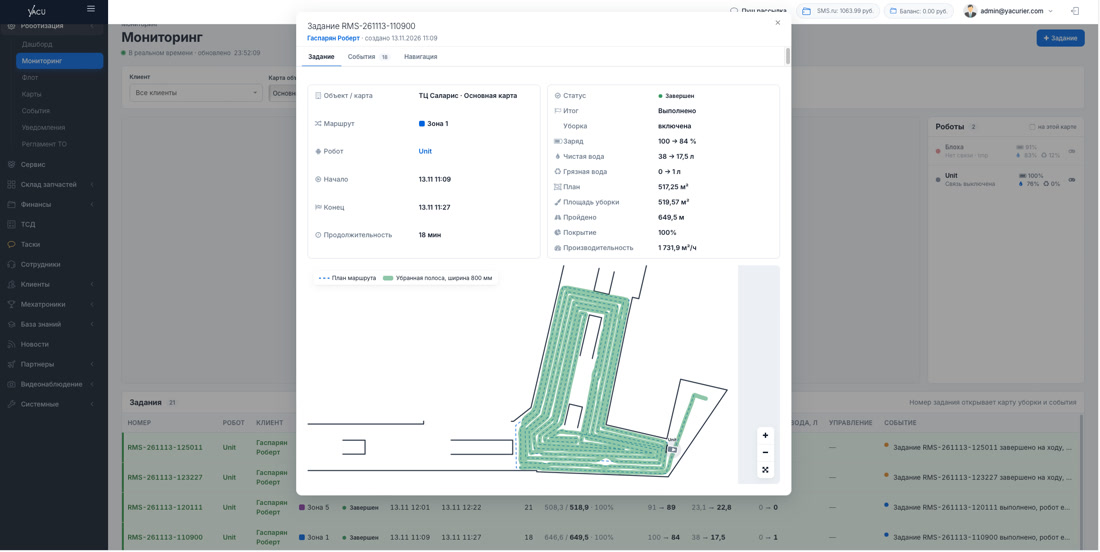
Frequently asked questions
What loads can a warehouse transport robot carry?
CarGo 300 carries unit loads up to 300 kg in total on a 900×560 mm deck: boxes, totes, containers, completed orders and packaging. For pallets, use the FMR autonomous forklift.
Do we need floor markings or magnetic tape?
No. The robot drives the route once and builds a map. For centimetre-level RTLS accuracy, compact anchors are mounted on walls or under the ceiling — the floor stays untouched.
Can the robot be integrated with our WMS?
Yes. Tasks can be sent from a phone or the web interface, and with integration they arrive from your WMS automatically. Multiple robots are managed in RMS.
Is it safe around people and forklifts?
Yes. Driver 2.0 has two safety layers: the local one stops the robot when a person suddenly appears, the global one plans detours. Speed is reduced automatically in narrow aisles.
How much does a warehouse transport robot cost?
CarGo 300 starts from $14,500 depending on order volume. When it replaces manual cart trips, the robot typically pays back in under a year.
How long does deployment take?
A few hours: mapping, setting points and routes, and a short briefing for staff. If RTLS is needed, anchor installation is added.
Related articles
 Inside CarGo 300: a robot that simply picks up and moves loads
 How Warehouse Robots Are Controlled: Three Levels of Control
 AMR (Autonomous Mobile Robots): The Future of Warehouse Automation
 How to Choose a Warehouse Robot: A Complete Guide
 Warehouse Robots: A Revolution in Logistics and Warehouse Management
 Driver Software-Hardware Suite 2.0
Warehouse and transport robots by YaCu
Leave a request — we will analyse your flows, calculate the number of robots and payback and send you the CarGo 300 presentation.
Or call us: +1 (888) 831-8224