


 Telegram
Inside CarGo 300: a robot that simply picks up and moves loads
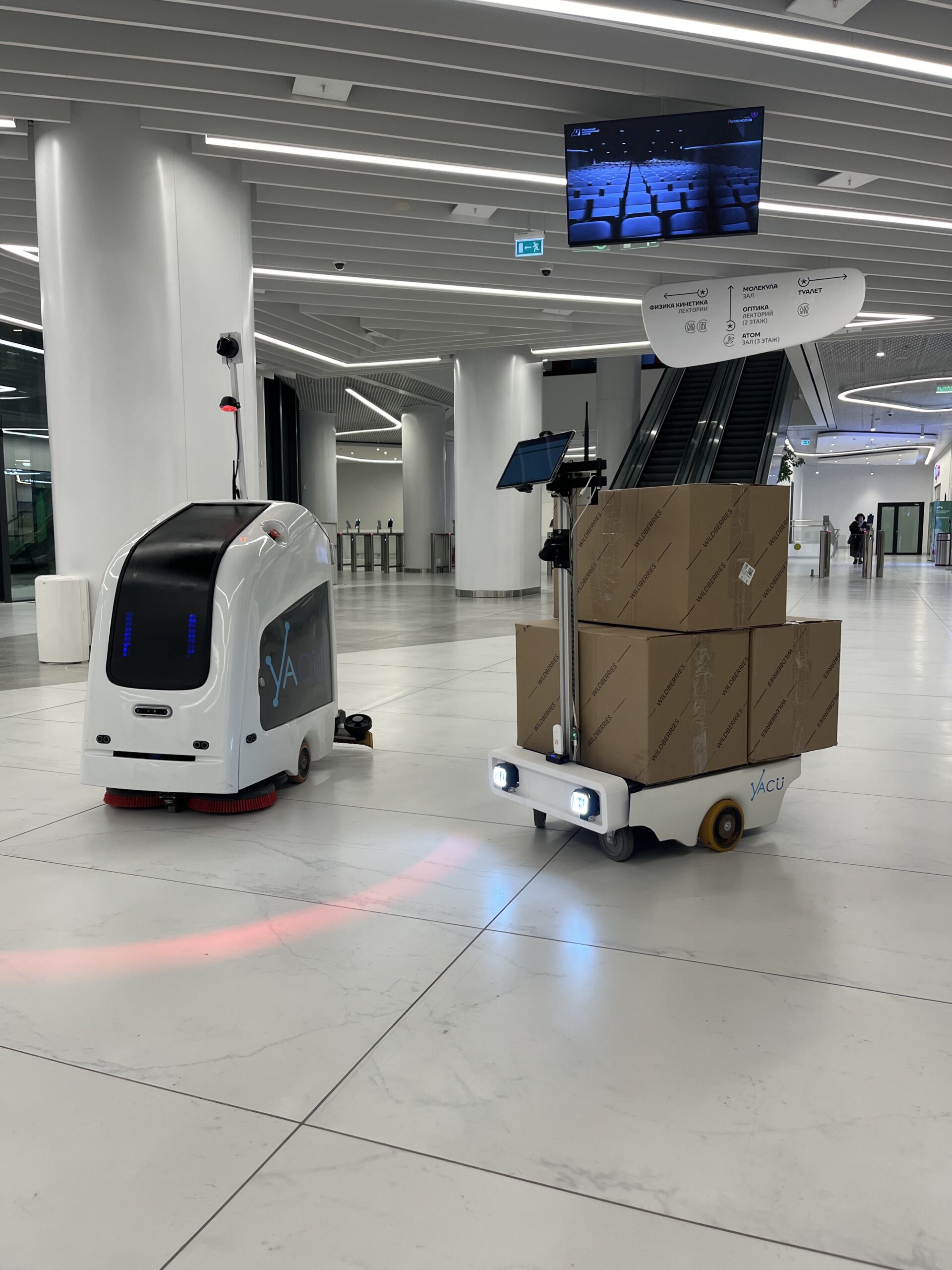
When we started YaCu Robotics by building the Driver hardware and software suite, our goal was not simply to release yet another cargo cart. We wanted to prove that real automation is when complex technology becomes invisible and using it becomes simple and profitable.
Our flagship product, the Unit cleaning robot, has been proving this for several years across thousands of square metres of cleaned floor. We automated a Toyota Prius, integrated our software into stackers and helped manufacturers make their machines smart. But all this time one thought haunted us: why is the most common, most in-demand need in the market still covered either by expensive solutions from large vendors or by the hands of loaders?
We mean moving loads of up to 300 kilograms. Not pallets, not containers, but exactly the volume that moves every day inside thousands of warehouses, factories and distribution centres. Monotonously and predictably — yet at a cost that could go into development rather than wages for low-skilled work.
That is how CarGo 300 was born: a 300 kg autonomous mobile robot that needs no magnetic tape, is not afraid of people and vehicles around it, does not get lost on complex routes and is controlled from an ordinary smartphone.
Why we deliberately avoided calling it a “cargo platform”
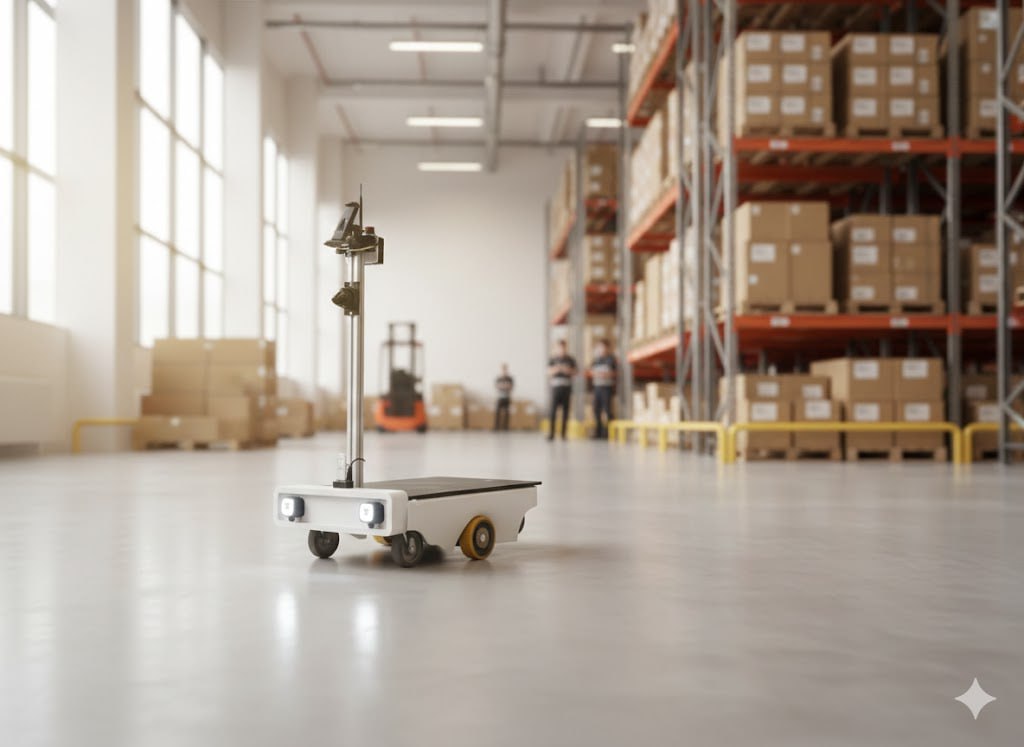
When you first look at CarGo, you see a platform: a rectangular 900x560x250 mm frame, four wheels, a body. But inside is everything we learned to do over years of developing the Driver platform.
That is why we deliberately do not call CarGo a “cargo platform”. The industry uses that term for dozens of devices, from non-automated carts to metal frames without a single sensor. Our product is an autonomous mobile robot (AMR). The difference is fundamental.
AGVs follow a rigid track: magnetic tape, wires in the floor, reflectors. Any deviation from the route means a stop and an operator's help. An AMR, the class CarGo belongs to, works differently. It builds its own map of the premises, makes its own decisions and drives around obstacles by itself. It does not need infrastructure. It needs a task.
That is the freedom we wanted to give our customers. CarGo 300 is a 300 kg autonomous mobile robot that can be put to work in a few hours, not months.
Hybrid SLAM+RTLS navigation: a guaranteed route, not just “the robot drives”
The scariest thing about automation is not its cost but its unreliability. When a robot “generally” drives but sometimes gets lost, stops in the middle of an aisle or misses a turn, trust in the technology collapses instantly.
So we did not choose between two approaches. We built hybrid SLAM+RTLS navigation.
SLAM gives the robot freedom. It arrives at the site, drives the route once and remembers everything: walls, racks, columns, aisles. No markers and no changes to infrastructure.
RTLS gives the robot absolute accuracy. Even in the most dynamic environment — with people, forklifts and other vehicles constantly moving — CarGo knows its position to within centimetres.
Together they give what we call 100% route execution. This is not a marketing slogan; it is a technical characteristic. If a route is set, CarGo will complete it — in any lighting, with any traffic in the aisles and any number of temporary obstacles.
Hybrid SLAM+RTLS navigation guarantees that the robot will not get lost even in dense traffic of people and vehicles. Free navigation means driving around any obstacle without stopping the mission.
Control without remotes or complex training
For many years we have watched “robotic” solutions being deployed. Often the hardest part is not the robot itself but the interfaces people use to work with it: separate remotes, laptops with installed software, calling a programmer to change a task.
CarGo is designed differently. The entire user experience fits on a smartphone screen.
Calling the robot from a phone is not an add-on but a core feature. Open the app, choose a task, send it. Prefer a computer? The web interface works in any browser. No “robot management specialists”. There is an employee, a task and CarGo.
This directly affects the economics of deployment. When we tell customers that CarGo starts at about $11,000–14,500 depending on order volume, many do not believe it, because they are used to AMRs with similar specifications from large vendors costing $33,000 and up — and that is only the hardware, before deployment, training and integration. CarGo does not need all that. It just drives.
The Driver platform: technology that works everywhere
For those who know our story, there is nothing surprising about CarGo. Inside it runs Driver, our own autonomous driving platform, which we have refined for years on Unit robots, passenger cars and industrial stackers.
What makes Driver unique is that it is not “firmware for one task”. It is a complete suite that can automate any wheeled vehicle. Want to make your forklift fleet smart? Driver can be installed on them. Want to automate deliveries inside a plant? We have already done that with CarGo. Want your floor scrubber to drive itself? Meet Unit.
But for the intralogistics market CarGo is the most ready-to-use, packaged solution. You do not need to be an engineer or understand sensors and algorithms. You simply get a 300 kg autonomous mobile robot that already knows how to drive, avoid obstacles and return to its charger.
One robot — hundreds of tasks
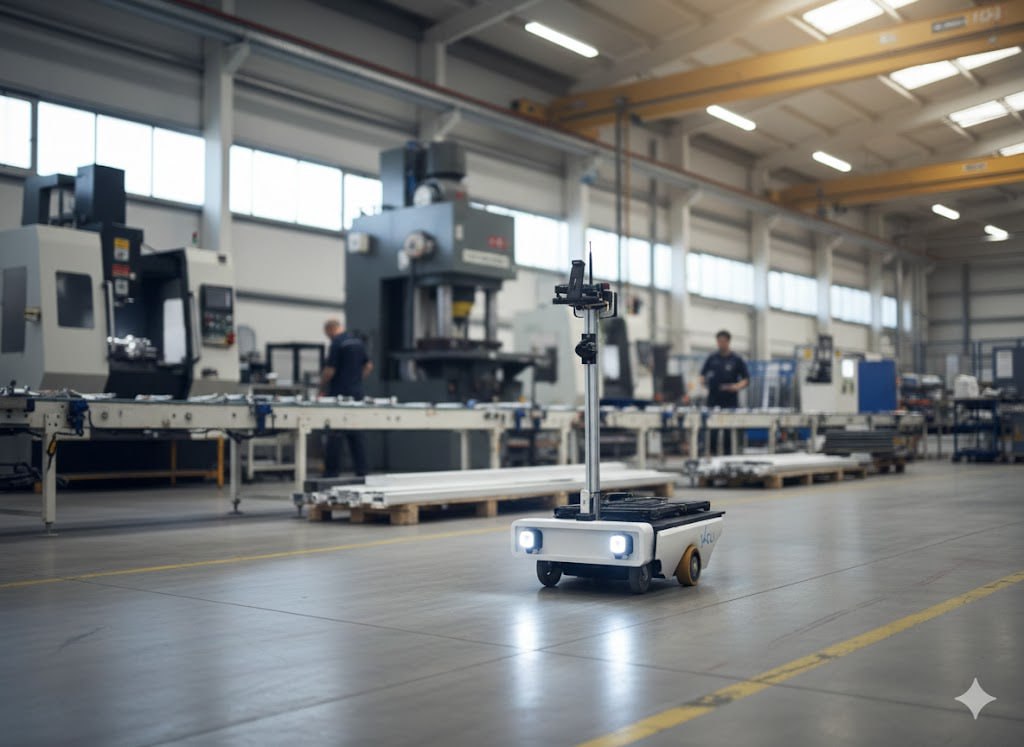
We did not design CarGo for one specific industry. That is a matter of principle. Warehouses, manufacturing, distribution centres, pharmaceuticals, automotive plants — everywhere there are loads up to 300 kg that need to be moved regularly.
In its first deployment at a large automotive plant, CarGo carried parts from the storage area to the assembly line. The route was several hundred metres long, in dense traffic of people and vehicles. The robot coped.
At the next site it will carry containers with components. At the third, finished products to the shipping area. CarGo does not care what is on its platform. What matters to it is where to go.
The app and web interface let you change tasks instantly. Today CarGo works on kanban, bringing parts on request. Tomorrow it is switched to cyclic runs between workshops. The day after, to removing packaging waste. This is not replacing one robot with another. It is one robot that adapts to the current needs of the business.
Economics you can calculate
Specifications, pricing and a quote request are on the CarGo 300 AMR robot page.
We do not ask you to take our word for it. CarGo's economic model is transparent.
Depending on the region, a warehouse loader costs from about $1,000 to $1,500 a month including taxes and contributions — roughly $12,000–18,000 a year. CarGo, starting at about $14,500, pays back in around a year. After that it works for pure profit.
At the same time CarGo does not take sick leave, does not need a mentor, does not damage loads out of fatigue and works three shifts without breaks.
We understand that comparing a person and a robot is always risky. People are irreplaceable in complex, non-standard and creative tasks. But carrying boxes along a predictable route is not a task that needs a person. It is a task that needs reliability, predictability and low cost.
Technology that is not afraid of difficult conditions
Back to navigation. Why do we insist so much on hybrid SLAM+RTLS navigation?
Because real warehouses and factories are not sterile exhibition stands. Racks get rearranged; temporary batches of goods are stored in aisles; forklifts drive around without giving way to robots; people go about their business without looking around; lighting is uneven and navigation markers get covered in dust.
Ordinary AMRs start making mistakes in such conditions. CarGo does not. SLAM gives it the context of the premises, RTLS an absolute coordinate grid. The robot always knows where it is, even if it is briefly “blinded” by a passing forklift.
This is not just convenient. It means CarGo can be trusted to work without constant supervision. And that is the main thing that separates a mature engineering solution from an experimental one.
In conclusion
CarGo 300 is not the first AMR on the market, and it will not be the last. But it is our answer to the question of what intralogistics robotization should look like.
Affordable. Reliable. Simple.
A 300 kg autonomous mobile robot. Hybrid SLAM+RTLS navigation. Calling from a phone. Driver inside. Everything your business needs outside.
Just give it a task. It is already on its way.